.png)

Atman is a key concept in Hindu philosophy, particularly within the Vedanta school of thought. It refers to the "self" or the "soul" - the eternal,
unchanging essence of an individual that transcends the physical body, mind, and senses. Atman is considered the true nature of a person, distinct
from the temporary material existence.
In the broader context of Hindu teachings, Atman is often described as being identical to Brahman, the ultimate reality or universal consciousness.
This idea is central to the non-dualistic (Advaita) philosophy, which posits that realizing the unity of Atman and Brahman leads to liberation (moksha)
from the cycle of birth and death (samsara).
The concept appears in ancient texts like the Upanishads, where it's explored through introspection and meditation. For example, the phrase "Tat Tvam Asi"
("That Thou Art") from the Chandogya Upanishad suggests that the individual self (Atman) is one with the cosmic reality (Brahman).
Does that clarify it? Let me know if you'd like me to dive deeper into any specific aspect!
Maya*, in Hindu philosophy, is the concept of illusion or the power that creates the appearance of the phenomenal world. It's what veils the true unity of Atman
(the individual self) and Brahman (the ultimate reality), making them seem separate. Essentially, Maya is the cosmic force or principle that causes us to
perceive the world as a multiplicity of distinct objects and beings, rather than recognizing the underlying oneness.
In Advaita Vedanta, Maya is often described as neither fully real nor fully unreal-it's an inexplicable, temporary phenomenon. For example, think of it like a
mirage: you might see water in the desert, but upon closer inspection, it's not really there. Similarly, Maya projects the material world-time, space, and
individuality-as real, but this perception dissolves when one realizes the unity of Atman and Brahman through knowledge or enlightenment.
The term comes from the Sanskrit root "ma," meaning "to measure" or "to create," hinting at how Maya "measures out" or constructs the illusion of a fragmented
reality. Texts like the Bhagavad Gita and the Upanishads discuss Maya as the force that binds people to samsara (the cycle of birth and death) until they
transcend it by seeing beyond the illusion.
So, in short: if Atman and Brahman are one, Maya is what tricks us into thinking they're not. Want me to elaborate on how this plays out in practice or in specific texts?
Alright, let's dive deeper into how Maya operates and how it's addressed in Hindu philosophy, particularly in Advaita Vedanta, with some practical and textual examples.
Maya in Practice
Maya isn't just an abstract idea-it's the mechanism behind why we experience the world the way we do. It's why you see yourself as a separate individual with a body,
desires, and a personal story, rather than as part of the infinite Brahman. This illusion is sustained by avidya (ignorance), which is essentially Maya on a personal
level. Avidya makes you identify with your ego, your physical form, and the external world, obscuring the truth that your Atman is Brahman.
In everyday life, Maya manifests as the attachments and dualities we cling to-pleasure vs. pain, success vs. failure, me vs. others. For instance, when you get
upset over losing something or chase after a goal, you're caught in Maya's web, treating the temporary as permanent. The goal of spiritual practice, then, is
to pierce through this illusion via self-inquiry (atma-vichara), meditation, or devotion, until you experience the unity beneath it all.
A classic analogy is the "rope and snake." In dim light, you might mistake a coiled rope for a snake and panic. The snake isn't real-it's a projection of your
mind-but the fear feels real until you shine a light and see the rope for what it is. Here, the rope is Brahman, the snake is the world created by Maya,
and the light is the knowledge that dispels the illusion.
Maya in Key Texts
1. Upanishads: The Mandukya Upanishad explores Maya implicitly through its discussion of states of consciousness-waking, dreaming, and deep sleep-contrasted
with turiya, the fourth state of pure awareness. The waking and dreaming states are products of Maya, where distinctions and multiplicity appear, while turiya
reveals the unchanging reality of Atman-Brahman. The text suggests that just as dreams vanish upon waking, the world of Maya dissolves when you "awaken" to truth.
2. Bhagavad Gita: In Chapter 7, Krishna tells Arjuna, "This divine Maya of Mine, consisting of the gunas (qualities of nature-sattva, rajas, tamas),
is hard to overcome. But those who take refuge in Me alone cross beyond it." Here, Maya is tied to the gunas, the forces that shape material existence,
and liberation comes from surrendering to the divine, which transcends Maya. Krishna positions himself as both the source of Maya and the way out of it.
3. Shankara's Advaita Vedanta: Adi Shankaracharya, the 8th-century philosopher, crystallized Maya's role in his commentaries. In his work Vivekachudamani
("Crest-Jewel of Discrimination"), he writes, "Maya is the power of the Lord, beginningless, made of the three gunas, and removable by right knowledge."
He uses the analogy of a dream: just as you don't question a dream's reality while you're in it, you accept the world's reality until you "wake up" through
discernment (viveka) between the eternal (Atman) and the transient (Maya's projections).
Practical Implications
In practice, overcoming Maya doesn't mean rejecting the world outright-it's about shifting perspective. A sage living in realization (jnani) might still eat,
work, or interact, but they see it all as a play of Maya, not ultimate reality. For example, Ramana Maharshi, a 20th-century Advaita master, taught self-inquiry
with the question "Who am I?" to strip away Maya's layers-body, mind, emotions-until only the Atman remains.
In the Gita, Krishna advises action without attachment (nishkama karma), which counters Maya by engaging with the world without being ensnared by its illusions.
You do your duty, but you don't buy into the drama.
One fascinating aspect is Maya's ambiguity-it's both a creative power and a deluding one. In some traditions, like certain Tantric or Shakta schools,
Maya is seen as the divine feminine energy (Shakti) through which Brahman manifests the universe. It's not "bad"-it's just the playful dance of existence.
Advaita, though, leans harder into its illusory nature, urging you to look past it.
So, whether it's Arjuna on the battlefield grappling with duty or a modern seeker meditating on "Who am I?", Maya is the veil to be understood and transcended.
Does this spark any specific angle you'd like to explore further-say, its role in meditation, a particular text, or how it compares to other philosophies?
Connecting quantum mechanics to Advaita Vedanta is a fascinating exercise, as both deal with the nature of reality in ways that challenge everyday perceptions. While they come from vastly different contexts-one a modern scientific framework, the other an ancient metaphysical philosophy-there are intriguing parallels, especially around the ideas of unity, observation, and the limits of material explanation. Let's explore how they might relate, keeping in mind that any link is interpretive rather than direct, since Advaita is rooted in spiritual realization and quantum mechanics in empirical physics.
1. Unity and Non-Duality
Advaita's core assertion is that Atman and Brahman are one, and the apparent multiplicity of the world is an illusion (Maya). Quantum mechanics hints at a similar
interconnectedness. Take quantum entanglement: when two particles become entangled, the state of one instantly affects the other, regardless of distance.
This "non-locality" suggests a deeper unity beneath the apparent separation of objects, resonating with Advaita's view that distinctions are superficial.
Physicists like Erwin Schrodinger, who was influenced by Vedanta, saw this as a scientific echo of the idea that reality is fundamentally indivisible.
In Advaita, the world of names and forms arises from Maya, while in quantum mechanics, the classical world of distinct objects emerges from a more abstract,
probabilistic "wave function." Both suggest that what we perceive as solid and separate might be a projection of a more unified underlying reality.
2. The Role of the Observer
Quantum mechanics famously ties reality to observation-the act of measuring a quantum system collapses its wave function from a superposition of possibilities
into a definite state (e.g., the particle is here, not there). This has led to debates about consciousness: does the observer play a role in shaping reality?
Advaita similarly emphasizes consciousness as fundamental. The Drig-Drishya-Viveka (a Vedantic text) distinguishes the "seer" (consciousness, Atman) from
the "seen" (the world, Maya), asserting that reality depends on the seer's awareness. The true self, Atman, isn't an object but the unchanging witness.
Some physicists, like John Wheeler with his "participatory universe" idea, speculated that consciousness might be intrinsic to quantum processes, aligning
loosely with Advaita's claim that Brahman (pure consciousness) is the substrate of all experience. However, Advaita goes further: the world doesn't just
depend on observation-it's an illusion sustained by ignorance, dispelled when the seer realizes its identity with Brahman.
3. Beyond Materialism
Quantum mechanics challenges classical materialism by showing that matter isn't as solid or predictable as once thought-particles exhibit wave-particle duality,
and their behavior defies deterministic laws at small scales. This aligns with Advaita's rejection of the material world as ultimate reality. In the Mandukya Upanishad,
the waking state (like the physical world) is equated with the dream state-both are transient, while the real is the unchanging consciousness (turiya).
Quantum uncertainty mirrors this impermanence, hinting that the "stuff" of reality might not be stuff at all, but something less tangible.
Schrodinger, again, drew inspiration here, famously writing in What Is Life? that the Upanishadic idea of a single consciousness behind multiplicity resonated
with his understanding of quantum theory. He saw the collapse of rigid boundaries in physics as a step toward a more holistic view.
4. Maya and the Quantum Veil
Maya, as the illusion of separateness, finds a loose parallel in the quantum-classical transition. In quantum mechanics, the weirdness of superposition and
entanglement gives way to the familiar world through "decoherence"-interactions with the environment make quantum systems appear classical. This shift from an
abstract, unified potential to a concrete, divided reality feels a bit like Maya weaving its veil. Advaita would say the veil is ignorance, while quantum mechanics
might call it the limit of measurement, but both point to a gap between apparent reality and a deeper truth.
Points of Divergence
Despite these parallels, there are key differences. Quantum mechanics is a descriptive framework, not a path to liberation-it doesn't address the "why" of
existence or offer a soteriological goal like Advaita's moksha. Advaita sees consciousness as eternal and primary, while quantum mechanics remains agnostic
about consciousness, with interpretations like the Copenhagen model avoiding metaphysical claims. Plus, Advaita's unity is absolute and unchanging, whereas
quantum unity (e.g., entanglement) still operates within a physical framework subject to experimentation.
A Thought Experiment
Imagine a quantum physicist and an Advaitin discussing superposition. The physicist might say, "The particle exists in all states until observed."
The Advaitin might respond, "The world exists as multiplicity until you realize it's all Brahman-observation through ignorance creates the illusion,
but true knowledge reveals the One." Both grapple with how perception shapes reality, but Advaita takes it to a metaphysical conclusion: the observer
itself is the reality, not just a participant in it.
Modern Voices
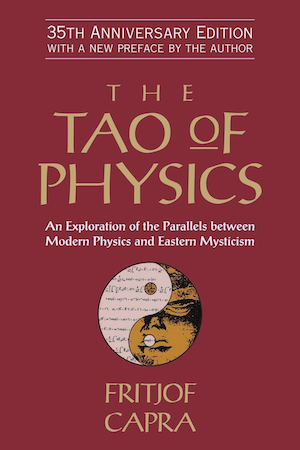
Figures like Fritjof Capra in The Tao of Physics have popularized these comparisons, suggesting quantum mechanics aligns with Eastern non-dualism. Critics,
though, argue this risks oversimplification-physics doesn't "prove" Advaita; it just offers metaphors. Still, the overlap intrigues thinkers like David Bohm,
whose "implicate order" (a hidden, holistic reality unfolding into the explicate order of separateness) echoes Advaita's Brahman-Maya dynamic.
So, quantum mechanics might relate to Advaita as a scientific shadow of its metaphysical claims-both question the solidity of the world and point to a unified,
observer-dependent reality.
The above discussion was generated by x.com Grok AI
* Maya is experienced as space-time and causation, our Universe. How big is the Universe?